Meta Andromeda 2.0: What the Update Means for Ad Tracking and Performance

CTO, lead-metrics.com
On October 28, 2026, Meta introduced the next generation of Andromeda on its engineering blog. Andromeda is the system that preselects the right ads for every impression. The industry mostly calls the update "Andromeda 2.0". Meta itself does not use that name and speaks of the next generation, or "The 2026 Meta Andromeda".
In this article we show what changes technically, what Meta says about it and what it does not, and what the update means for ad tracking and the performance of your campaigns. As of November 2026.
Key takeaways
- What is new: according to Meta, Andromeda now scores every eligible ad with near ranking-level quality, at over one billion ads per second. That is about 100 times as much as the 2024 system.
- Result according to Meta: Andromeda has delivered 2.4% more conversions on Facebook since 2025.
- No new setting: Meta names no new option and no new campaign type. The update works automatically in the background.
- Tracking matters more: the better Meta's models predict, the more depends on which conversions you send through the Conversion API and the Meta Pixel, and how completely they arrive.
- Creatives: more ads in competition means that different concepts count for more than many near-identical variants. Meta has not published a fixed rule on this, though.
What Meta Andromeda is
Before Meta shows an ad, several stages run. The first one is ad retrieval: from all ads that are eligible for a person, the system picks a small set of strong candidates within milliseconds. Ranking models then score these candidates in detail, and the auction decides which ad is shown.
Meta Andromeda is Meta's system for this first stage. In its first version from 2024, according to Meta, it selected a few thousand candidates from tens of millions of ads (Meta Engineering, December 2024). An ad that does not make it into this preselection has no chance for that impression, however high the bid.
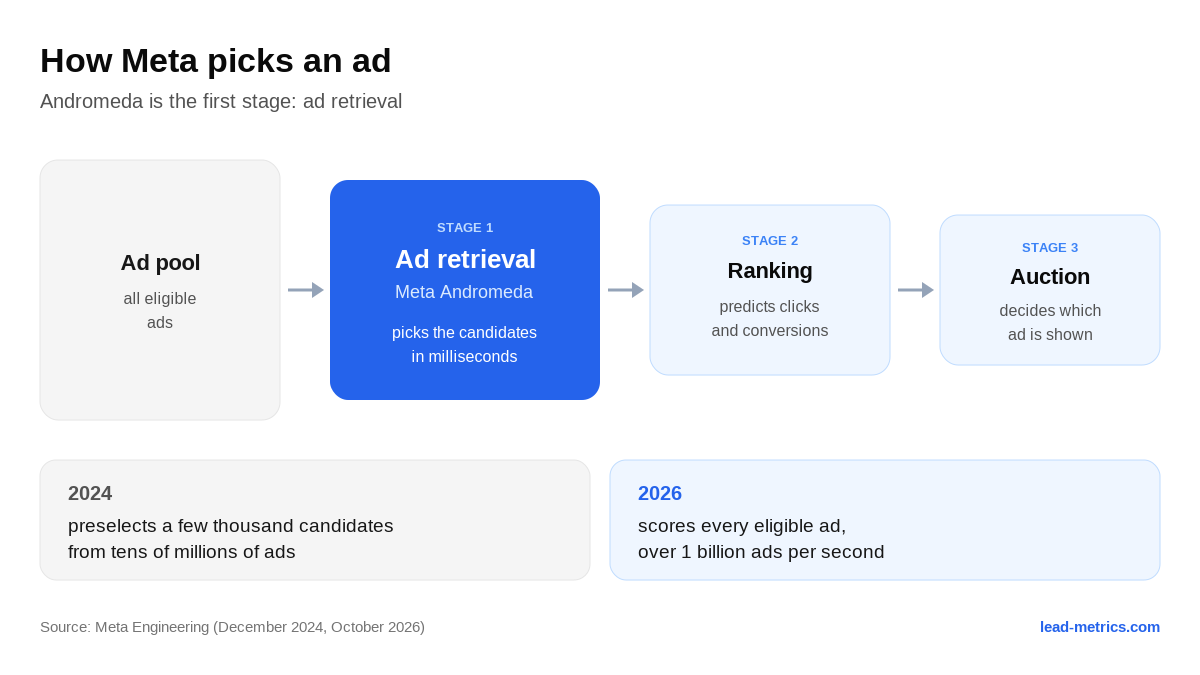 How Meta picks an ad: Andromeda handles the preselection before ranking and auction
What changes with the new generation
Meta describes the new generation in the post "Meta Andromeda: Powering the Next Generation of Ads Retrieval Through Model-System Co-Design". The main differences according to Meta:
| Andromeda 2024 | Andromeda 2026 | |
|---|---|---|
| Task | preselect a few thousand candidates from tens of millions of ads | score every eligible ad with near ranking-level quality |
| Throughput | tens of millions of ads per second per GPU | over 1 billion ads per second, about 100 times more |
| Model | custom neural network with a hierarchical index | mixture-of-experts model inspired by large language models, about 300 times fewer operations per inference |
| Impact stated by Meta | +6% recall, +8% ads quality in selected segments | +2.4% conversions on Facebook since 2025 |
Instead of a single model for the user side, Andromeda now works with several specialized sub-models called experts. A gating network decides how much each expert counts for a combination of person and ad. In addition, index matching, scoring and selecting the top candidates now run together on one GPU server. According to Meta, the pipeline scores every eligible ad across Facebook and Instagram this way.
Why Meta built it
Meta explains the rebuild with the volume of ads. Generative AI tools have helped advertisers create hundreds of millions of new ads, driven by Advantage+ automation and Meta's generative creative tools. The bigger the pool, the more important it is that the preselection does not miss the right ads.
What Meta promises advertisers
According to Meta, advertisers get "better performance automatically" because the system matches ads across a larger candidate pool within the same latency budget. The result is "better customer matches and more conversions". Meta does not mention a new setting, an opt-in or a new campaign type.
What Meta did not say
Many articles on Andromeda 2.0 name fixed rules, such as "similar ads are treated as one" or a minimum number of creatives per ad set. Meta's engineering posts on Andromeda say none of this. In 2024 Meta only wrote in general terms that more diverse ads can improve people's experience and lead to better outcomes for advertisers.
So these rules are rules of thumb or assumptions, not confirmed mechanisms. Treat them as hypotheses and test them against your own numbers.
Impact on performance
More ads get a serious look
Until now Andromeda presorted roughly, and only a small share of ads was scored in more detail. Now, according to Meta, the system scores every eligible ad with near ranking-level quality. Our assessment: ads that fit a specific person well are found more reliably, even if they come from small accounts or niches. Conversely, weak ads are less likely to slip through just because the rough preselection was imprecise.
Creatives: concepts, not variants
Meta's models represent ads as learned features. Ads that barely differ, for example only in the headline or the button color, look very similar to the system. Our assessment: ten near-identical variants are then more likely to compete for the same people than to reach new ones.
Different concepts do more: a different problem, a different hook, a different format, a different audience in the messaging. Keep an eye on creative fatigue, because good concepts wear out too.
Putting changes in context
Meta has been rolling out Andromeda gradually since 2025, and the 2.4% refers to that period. Changes in your campaigns since the end of October 2026 are therefore not automatically caused by the update. Before you change anything, compare several weeks and check whether budget, creatives or season have changed.
Impact on ad tracking
The models learn from your conversions
Andromeda selects the ads that are most relevant for a person. What relevant means, Meta learns from data: according to Meta, its central ads model GEM jointly predicts clicks and conversions across all surfaces (Meta Engineering, October 2026). These predictions are based on the conversions that reach Meta.
For lead campaigns this means: if you only send the submitted form, the system learns to find people who submit forms. Those are not necessarily the ones who buy. If you also send qualified leads, meetings or deals, Meta can optimize for those stages. How to choose the right stages is explained in the guide Sending pipeline stages as conversions to Meta and Google. For lead ads there is also the Conversion Leads performance goal, more on that in Low-quality leads from Meta Ads.
Missing conversions make the selection worse
The Meta Pixel alone loses conversions to ad blockers, Safari and missing consent. What does not arrive, no model can learn from. The Conversion API also sends the events from the server. So that nothing is counted twice, each event needs a shared event ID for event deduplication.
How well Meta can match events to people is shown by Event Match Quality. The more matching customer data (hashed) and click IDs an event carries, the better. Concrete steps are in the guide Improve Meta Event Match Quality.
Check Meta's numbers against your own data
The 2.4% more conversions are Meta's own measurement. In Ads Manager, too, you see conversions the way Meta attributes them. Whether your business is really growing only shows when you compare with your CRM: how are cost per qualified lead, deals and revenue per ad developing? If you want to know how many leads would not have happened without ads, you need a conversion lift test.
What you should do now
Check your signals
Does the Meta Pixel run together with the Conversion API? Do both events share the same event ID? How high is the Event Match Quality of your most important events?Optimize for the right stage
Send qualified leads, meetings or deals from your CRM to Meta and optimize for the stage that means revenue for you, not just the form.Plan creatives as concepts
Test different messages, hooks and formats instead of many variants of the same ad.Measure success outside Meta
Judge campaigns and ads by deals and revenue from your CRM, not only by the conversions in Ads Manager.
How LeadMetrics helps
LeadMetrics connects your ads to leads, deals and revenue and sends these events through the Conversion API to Meta, Google Ads, TikTok and LinkedIn. Email, phone and name are hashed with SHA-256 before sending, click IDs such as fbc and fbp are included, and an event_id takes care of deduplication with the pixel. Deals come natively from HubSpot and Close, or through webhooks, Zapier and Make.
In the dashboard you see cost per deal, revenue and ROAS down to the level of each ad. That way you can tell which concepts actually bring customers, not just which ones Meta credits with the most conversions. With TSO we are also building new tracking software, which is currently in beta.
Andromeda optimizes for what you send. With LeadMetrics you send Meta not just forms, but deals and revenue from your CRM.
Frequently asked questions about Andromeda 2.0
Is the update officially called Andromeda 2.0? No. Meta speaks of the next generation of Andromeda, or "The 2026 Meta Andromeda". "Andromeda 2.0" is an industry name.
Do I need to change anything in my campaigns? No. Meta names no new setting and no new campaign type. The update works automatically. It still makes sense to review tracking and creatives.
Are similar ads merged into one? Meta has not confirmed this. Near-identical ads are, however, likely to look very similar to the system and therefore reach hardly any new people.
Do I need the Conversion API? Meta's Andromeda post does not require it. Because the models learn from the conversions that arrive, we still recommend running the pixel and the Conversion API together, especially if you want to send deals from your CRM.
Does this apply to Instagram too? According to Meta, the pipeline scores every eligible ad across Facebook and Instagram. Meta states the 2.4% more conversions for Facebook only, though.
Ready for better tracking?
Discover how LeadMetrics helps you understand the true ROI of your marketing channels.
Try free for 10 daysRelated guides
How to Send Sales Pipeline Stages as Conversions to Meta and Google
Which pipeline stages to send to Meta and Google Ads as conversions, how to map them to events, assign values, meet upload deadlines and avoid duplicates.
Read guideHow to Improve Meta Event Match Quality: What Data to Send
How to improve Event Match Quality in Meta: which customer data counts, how to normalize and hash it, and how fbc, fbp and event_id help your score.
Read guide